Please Attention PHOENIX Readers: The Full Article Is Available via “Read Original”
Since after losing 2-0 to Mexico in the curtain raiser of the ongoing 2026 FIFA World Cup being co-hosted by the Central American nation, alongside their neighbours — the United States and Canada — questions have been raised whether the South Africa’s World Cup is barely over from the start.
The argument bothers not on the loss as teams have severally recovered from open day losses to make statements. For instance, in the last World Cup, eventual winners, Argentina — then understandably top favourites — lost their opening match 2-1 to Saudi Arabia but recovered to still win the tournament.
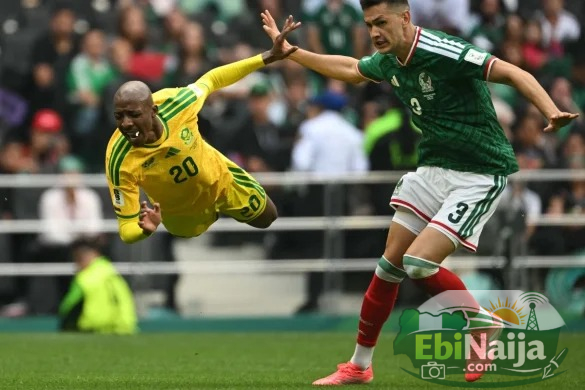
However, in the case of the Bafana Bafana of South Africa, their manner of losing was abysmal after they showed a high level of indiscipline, collecting two red cards and failing to mount any serious charge against the co-host.
It was quite a disastrous return for them to the World Cup for the first time since they hosted football’s biggest and greatest tournament 16 years ago.
Julián Quiñones got the co-hosts to the perfect start by slamming a powerful shot home after centre midfielder Yaya Sithole was caught taking a heavy touch 20 yards from goal, and came close to a second when he hit the base of the post.
Jiménez headed in the second to put the game beyond doubt either side of red cards to Sithole and Themba Zwane, before César Montes was shown red for the same offence as the former’s as El Tri achieved a first win over South Africa for 26 years.
However, since after the match, there have been trolling from most Africans, particularly Nigerians, who are calling out the Bafana Bafana following the loss. For Nigerians, they see South Africa as undeserving of their World Cup spot as both teams contested the sole Group C ticket in the CAF qualifiers, and some Nigerian fans are seeing the abysmal 2026 World Cup open day performance of the 1996 African champions as an opportunity to call them out.
To the broader Africans and also some Nigerians, the ongoing xenophobic attacks by South Africans to immigrants, particularly those from other African countries, might have made more enemies for the former apartheid enclave, hence the mocks and trolls in the aftermath of the result against Mexico.
According to a South African on X, Sibusiso Thulani, Africans should be ashamed of themselves for celebrating the defeat by Mexico.
“It’s unfortunate that the whole of Africans are celebrating our defeat just because we are South Africans,” he wrote.
“For whatever reason, we should be united but I think those celebrating our loss to Mexico should be ashamed of themselves because it is like rejoicing over the death of your relative,” he said.
However, can it be right to say that Africans celebrating the defeat of South Africa lack sense of objectivity? With certain factors,such argument can be understood.
In the qualifiers for a place at the 2026 World Cup, Nigeria, for example, found themselves in Group C alongside South Africa, Benin Republic, Rwanda, Lesotho and Zimbabwe. As the seeded team in that group, the Super Eagles were tipped, and rightly too, to beat all-comers to the sole ticket and that was understandable given the experience, talent and exposure of their squad.
But due largely to the cluelessness and shortsightedness of the Nigeria Football Federation (NFF), the Super Eagles failed to mount a serious challenge. Even when two lifelines were thrown at them — deduction of three points from the Bafana Bafana of South Africa and the consequent effect of the Super Eagles finishing second in the group and qualifying for playoffs — the former African champions failed to take advantage of that as the Democratic Republic of Congo also piped them to the intercontinental playoff slot.
NFF’s non-challance seems legendary. After Austin Eguaveon took over, albeit on interim basis, in 2024 and steadied the Super Eagles, qualifying Nigeria for the 2025 AFCON where they eventually finished third, it wasn’t South Africa that urged the NFF to toy with Super Eagles World Cup qualifiers by not allowing the coach to continue.
It wasn’t South Africa that urged the NFF to engage three coaches within the same qualifying window, leading to changes in tactics, approach and submissions. It wasn’t South Africa that urged the Super Eagles to drop vital points against obvious underdogs like Benin Republic who whipped the Eagles in a neutral ground, Abidjan, their adopted home.
The Super Eagles also dropped points at home to Zimbabwe, among other very abysmal results, even when they were expected to boss those countries. Truth is that NFF showed the highest level of insensitivity in the management of the team in the qualifiers when other teams in the same group, particularly, South Africa and Benin Republic, were showing tact, resilience and the desire to be at the Mundial.
Instead of mocking the former apartheid country, Nigerians, analysts believe, should channel their grievances over inability to qualify for the World Cup to the managers of the game in the country.
According to Mikel Obi while on his podcast, NFF failed to learn from the inability to qualify for the 2022 World Cup in Qatar as the same trivialities led to Ghana piping the country to the ticket in Abuja in 2021.
On the second factor militating against less support for the Bafana Bafana, which is bothering on immigration issues in South Africa, even before the World Cup opener, majority of Africans were unanimous in their support for Mexico, justifying their positions on the xenophobic issues in South Africa.
An X user wrote; “You want people to cheer for you when you play soccer just because we’re African?, citing reports of mistreatment of migrants.
“We’re supporting Mexico so that South Africa can go back home early to protect their jobs,” another user posted, playing on the unfounded accusation that foreigners were responsible for South Africa’s high unemployment rate.
“I hope South Africa is not blaming African migrants for the 2–0 defeat and two red cards in the match against Mexico,” posted Ahmednasir Abdullahi, a prominent Kenyan lawyer.
Others shared memes playfully embracing Mexican culture for the day, changing their profile pictures to Mexican flags and adopting Spanish-sounding names, under the caption “Mexico versus xenophobia”.
Meanwhile, according to a report by BBC, one Daniel Kaniki, a Congolese football supporter who was at a fan park in the US city of Atlanta, said: “Africa is like one country and if one is chasing others, we are not a family any more. That’s why I’m supporting Mexico today.”
However, while the actions of the former apartheid country in their attacks on immigrants stand condemnable, suffice to say that the continued migration of other Africans to South Africa and Europe is an indictment of the leadership of their countries.
According to statistics, African leaders are the most inconsiderate and insensitive set to the plights of their citizens, with hardship being enthroned as norms in most African countries through policies that favour only the ruling class and the first families.
Here in Nigeria, citizens abroad would prefer harsh relatives over there to returning home. For example, when the Federal Government directed that the citizens in South Africa should indicate willingness to come back home, the response from Nigerian citizens in South Africa merely showed the apathy towards the country. Only a few Nigerians indicated interest to leave their oppressors, a development analyst blamed on the extreme hardship in Nigeria, thus indicting the government, which many Nigerians see as not doing enough to improve the already bad situation in the country.
Last week and of so many Nigerians living in South Africa, only 258 returned to the country through Air Peace and were received by the Minister of Humanitarian Affairs and Poverty Reduction, Dr. Bernard M. Doro. The number paled into insignificance considering the number of Nigerians resident in the country.
SUNDAY INDEPENDENT gathered from Statistics South Africa, the country’s national statistics platform, that there are an estimated 30,000 to 500,000 Nigerians living in South Africa, and when less than 300 returning home willingly, it shows lack of trust in the country currently being threatened and plagued by a level of insecurity hitherto unseen in the history of Nigeria. This is apart from other areas of concern like the poor economy, poor electricity and all that.
This is almost similar to what obtains in most African countries and like said in the case of the Super Eagles’ failure to qualify for the World Cup, Africans should blame their home administrators for the poor management of their various ecobomies leading to hardships which continually force young men and women to migrate to other countries — in this case South Africa.
A returnee from South Africa, Farouk Mohammed, wrote on his X account that some of those who failed to return consider South Africa lesser evil.
“I decided to come back for a while but I want Nigerians to stop blaming those who decided to stay there,” he said.
“To them, South Africa, no matter how hostile, is a lesser evil considering what is happening in Nigeria today.
“We hear a lot while there and when you come back, relatives will warn you against moving around because of insecurity.
“So a lot of them consider staying there than coming to face the possibility of being kidnapped and things like that,” he said.
While South Africa’s Bafana Bafana can still bounce back from their poor start in their second match, analysts believe mocking them doesn’t quite solve the problem of insecurity and poor economy in Africa.